Western bridal media doesn’t know what to do with Asian brides. It keeps defaulting to one image a red qipao, maybe a gold headpiece, and calling it a day. That’s not the full picture. Asian brides are among the most style-diverse brides I photograph, and the choices they make are often far more considered than anything I see on a mainstream bridal blog. If you’re planning a wedding and looking for real context, you’re in the right place.
What Makes Asian Bride Style So Distinct From Western Trends
Picture this: a Korean bride in Seoul changing outfits three times in a single wedding day. First, a hanbok in deep jewel tones for the traditional ceremony. Then, a fitted ivory gown for the formal reception. Then something lighter for the after-party. That’s not indecision, that’s a deeply intentional approach to dress that Western bridal culture rarely mirrors. European Brides, as you can read about at European Brides and their unique wedding celebrations, tend toward one statement gown and let it carry the whole day. Asian bridal style often thinks in chapters.
The distinction runs deeper than outfit changes, though. For many Asian brides, the dress isn’t purely aesthetic. It carries weight. A Chinese bride wearing red isn’t just picking a bold color; she’s honoring centuries of symbolism around luck, prosperity, and family. A South Indian bride draped in a Kanchipuram silk saree is wearing fabric that might have taken a weaver in Tamil Nadu six weeks to finish. That context doesn’t disappear just because the venue has a DJ and a dessert table. And Western bridal trends, for all their reach, don’t always account for that. Body proportions, skin tones, family expectations, regional customs, all of it shapes what actually works on an Asian bride, and none of it fits neatly into a “top ten gowns” roundup.
Centuries of Tradition and Modern Runways Shape What Asian Brides Actually Wear
Why does the same bride sometimes look completely at home in both a structured Vera Wang silhouette and a hand-embroidered traditional garment? Because she’s drawing from two different but equally valid sources. Asian bridal style has never been frozen in time. It moves. Designers in Tokyo, Shanghai, Mumbai, and Jakarta are producing work that pulls from traditional textile arts while responding to what’s happening on international runways. The result isn’t fusion for its own sake it’s evolution with memory.
Take the qipao, or cheongsam. In the 1930s it was already a modernized version of older Manchu dress. What brides wear today is yet another iteration sometimes in blush instead of red, sometimes with a plunging back, sometimes shortened to a cocktail length. The shape is ancestral. The execution is contemporary. I’ve photographed brides in updated qipaos who told me their grandmothers wore nearly the same cut, just in different fabric. That continuity is real, and it shows up in the photos.
Japanese brides have their own version of this layering. The shiromuku, a full white kimono ensemble, remains the most formal option for Shinto ceremonies. But many Japanese brides also wear a Western-style gown for the reception, sometimes sourced from designers like Yumi Katsura who specifically bridges both traditions. The asiana bride aesthetic, broadly speaking, isn’t about choosing between old and new. It’s about knowing when each belongs.
So Which Wedding Dress Styles Are Asian Brides Choosing Right Now
The most popular wedding dress style among Asian brides right now is the Western white gown. That might seem obvious, but it’s worth saying plainly because so much bridal content still treats traditional dress as the default assumption. A-line silhouettes, off-shoulder necklines, and clean column dresses with minimal embellishment are consistently what I see brides requesting. Destination weddings especially push toward this. A bride planning a ceremony somewhere coastal will often look at destination wedding venues with that kind of clean, light aesthetic in mind.
Still, the second outfit, the traditional one, is making a strong comeback, particularly among younger brides who grew up in diaspora communities. A bride in her mid-twenties who was raised in Toronto or London but has family roots in Vietnam or the Philippines often wants both. The ao dai at the tea ceremony. The gown at the reception. It’s a way of holding two identities at once, and the photographs that come out of those days are a few of the layered and honest I’ve ever shot.
Specific numbers help here. At a South Asian wedding I photographed with around 400 guests, the bride wore four different looks across two days. A lehenga for the mehndi night, a heavily embroidered red bridal lehenga for the ceremony, a champagne saree for the reception, and a white gown for the send-off. Each look had its own logic. None of them was arbitrary.
- Red qipao or cheongsam: Chinese weddings, often worn during the tea ceremony
- Lehenga choli: South Asian ceremonies, ranging from deep reds to pastel pinks
- Hanbok: Korean ceremonies, typically in layered silks with wide skirts
- Shiromuku or furisode: Japanese Shinto ceremonies
- Ao dai: Vietnamese ceremonies, fitted tunic over wide trousers
One Style Won’t Fit Every Bride Asia Has to Offer
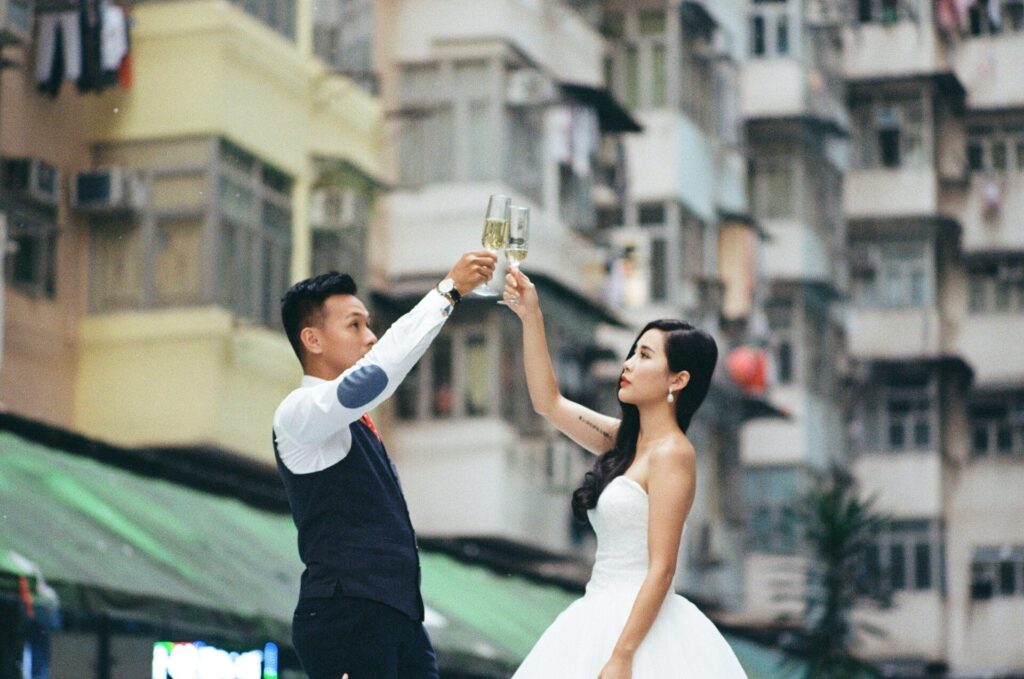
Asia is 48 countries. That single fact should end any conversation about “the Asian bride look” as if it’s one thing. A bride from the Philippines and a bride from Pakistan are drawing from completely different visual traditions, different family structures, different religious contexts, and different ideas about what a wedding even means. The mistake most bridal content makes is collapsing all of that into one aesthetic category for convenience.
Latin Brides face a similar kind of flattening. Actually, you can see how that plays out differently at Latin Brides wedding venues, where regional identity shapes everything from the dress code to the venue choice. Asian bridal diversity works the same way. A Sikh bride in a red anarkali and a Chinese-Australian bride in a sleek column gown are both making culturally informed decisions. Neither is more “authentically Asian” than the other.
For the bride asia-based fashion industry, this is actually a commercial reality. Bridal designers across the continent don’t market to “Asian brides” as one market. They market to Tamil brides, Cantonese brides, Javanese brides, and Tagalog brides. The specificity matters. And if you’re a bride reading this while figuring out your own look, that specificity is your advantage. You’re not choosing from one tradition. You’re choosing from dozens, and you get to decide how much of each one you carry into your wedding day. The bride who understands her own cultural context and shoots with a photographer who actually sees it ends up with images that will still mean something in forty years.